Stay updated


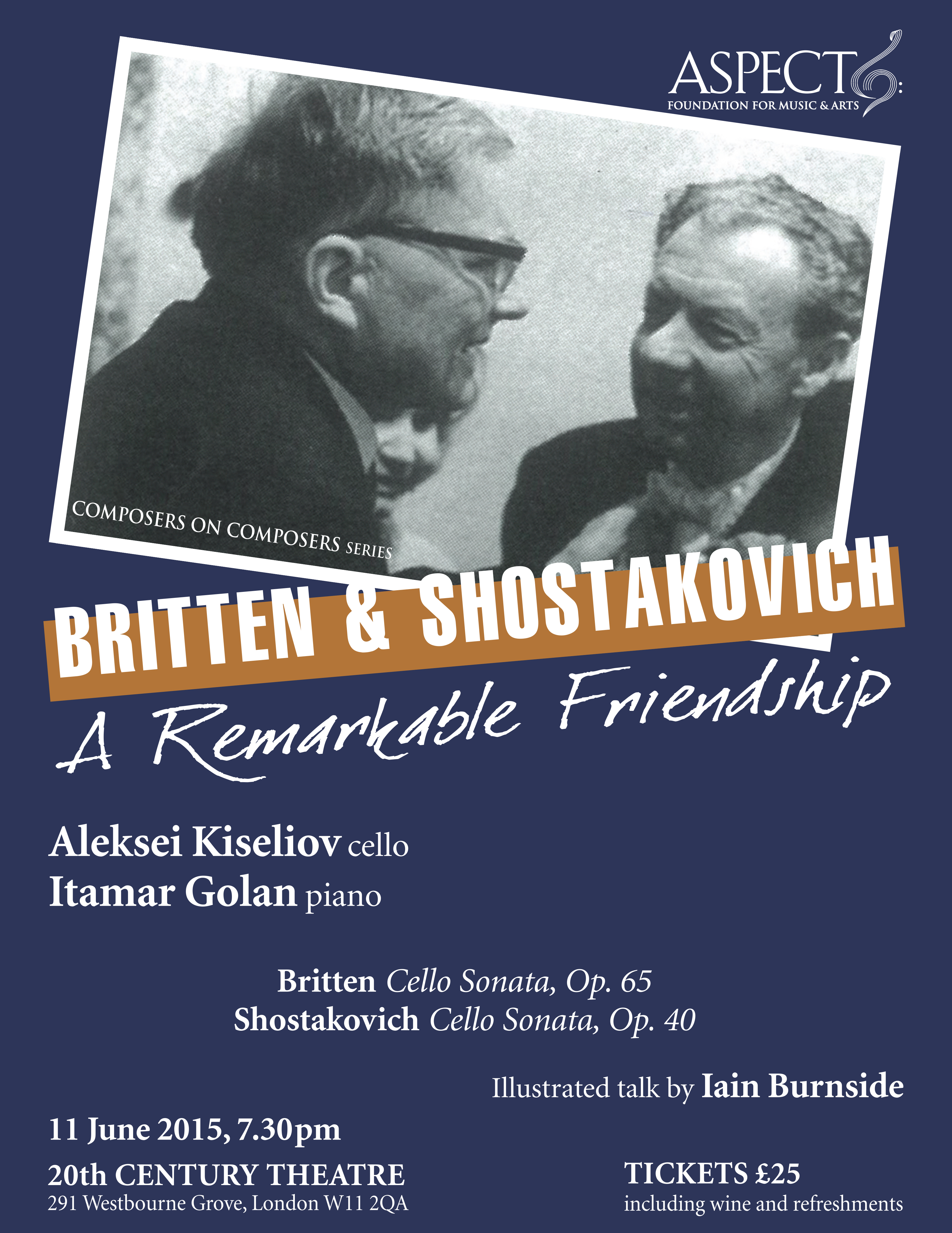
BRITTEN AND SHOSTAKOVICH: A REMARKABLE FRIENDSHIP

The catalyst was ‘Slava’, the charismatic cellist Mstislav Rostropovich: in 1960, at the height of the Cold War, he gave the UK premiere of Shostakovich’s First Cello Concerto, an event at which Britten met Shostakovich and Rostropovich for the first time. The two composers were both shy men, but recognised each other as kindred spirits as well as fellow artists. Britten’s immediate response was to pen his bold Sonata in C, in some ways a portrait of Slava, his courage, humour and suffering. Shostakovich’s own Cello Sonata dates from the creative crucible of his pre-war years when he was learning to subvert conventional forms in emotionally powerful ways. Britten said of Shostakovich, ‘no one composing today has equal influence on me’. Shostakovich responded by dedicating his Symphony No. 14 to Britten. 

Photos     Videos                                                                              11 June 2015

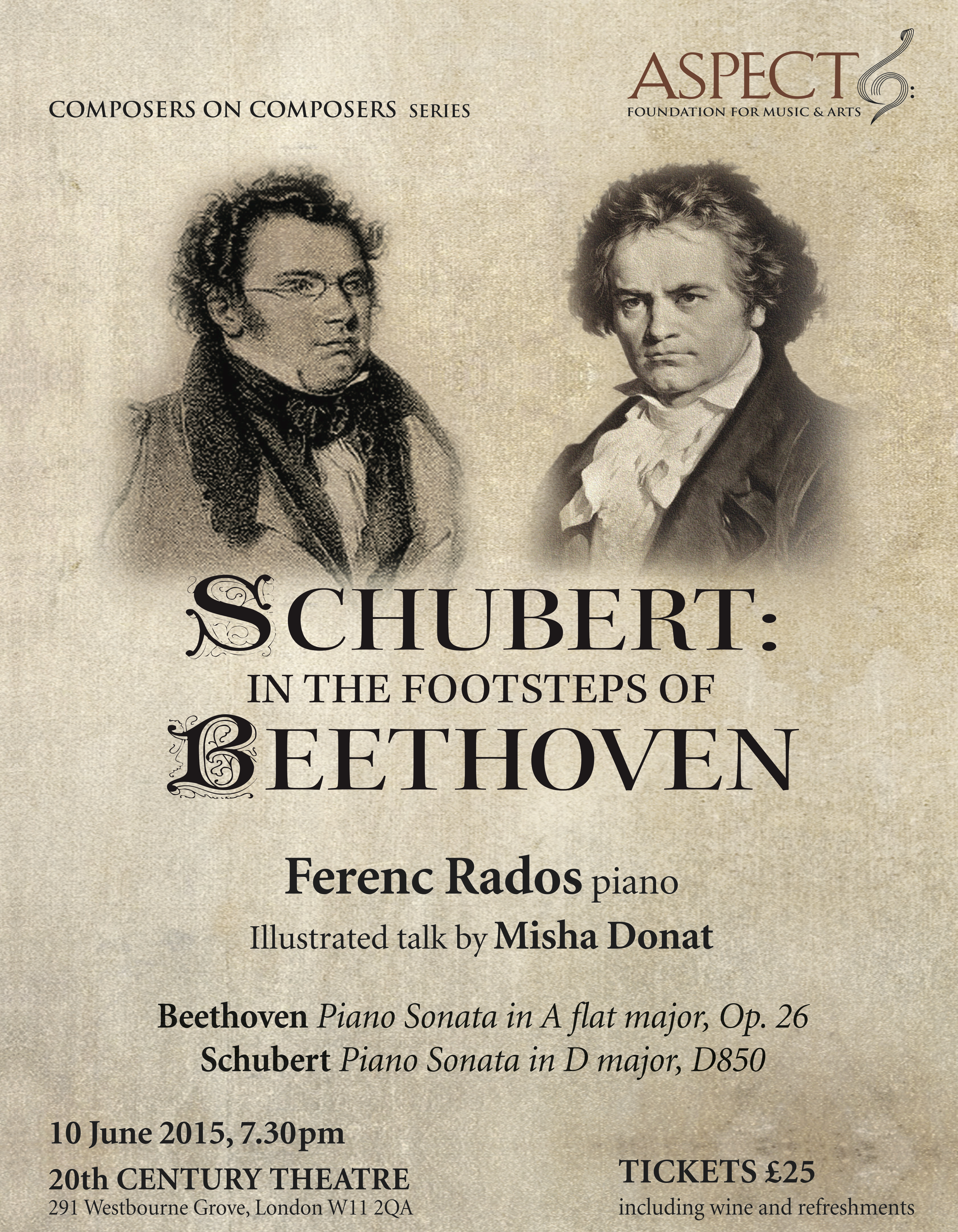
SCHUBERT: IN THE FOOTSTEPS OF BEETHOVEN

Schubert composed his piano sonatas at a time when the genre was in decline, and public taste favoured much less demanding fare. Only the awe-inspiring figure of Beethoven was exempt from the appetite for what Schubert once dismissed as ‘miserable Mode-Waare’ (wretched fashionable stuff). As a composer of Lieder, dances and shorter piano pieces, Schubert had seen his fame spread far beyond the confines of Vienna, but when it came to compositions on a larger scale his ambitions were constantly thwarted. The extent of his artistic legacy was so little known to his contemporaries that the epitaph for his tombstone, written by Austria’s leading dramatist, Franz Grillparzer, lamented: ‘The art of music here buried a rich possession, but far fairer hopes.’ Beethoven’s funeral, some eighteen months before, had been a much more public affair, and Grillparzer had written an oration very different in tone: ‘The man who inherited and increased the immortal fame of Bach and Handel, of Haydn and Mozart, is no longer; and we stand weeping over the broken strings of an instrument now stilled.’ 

Photos   Videos                                                                               10 June 2015 

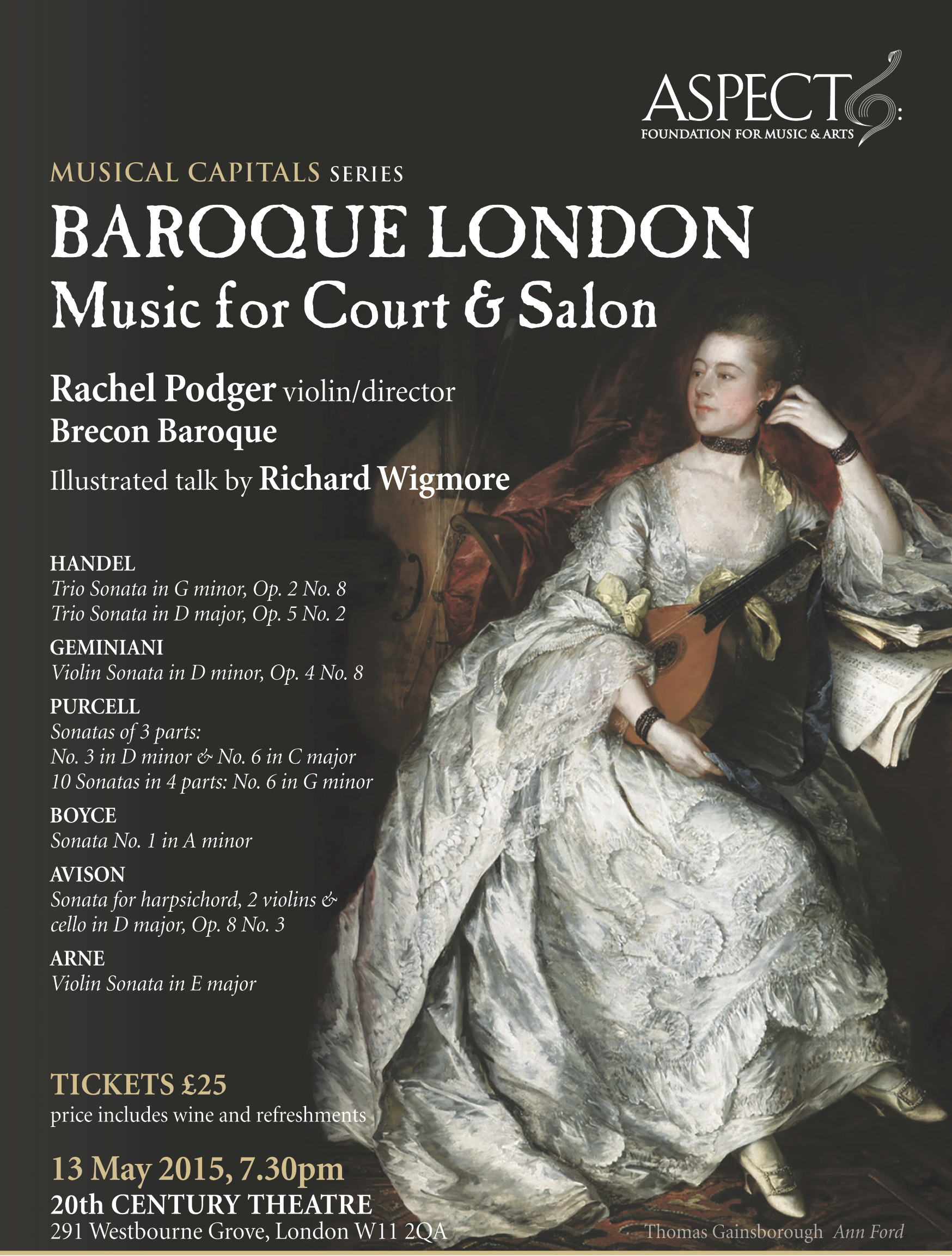
BAROQUE LONDON: MUSIC FOR COURT AND SALON

In the late seventeenth and early eighteenth centuries London was the most vibrant and cosmopolitan musical centre in Europe. Alongside music for theatre and chapel, a rich tradition of chamber music developed, whether for performance at court or in private salons. Rachel Podger and Brecon Baroque, together with speaker Richard Wigmore, celebrate Baroque London’s musical pre-eminence in a programme of string sonatas ranging from Purcell’s intricate, inward-looking sonatas in 3 and 4 parts to the breezy tunefulness of William Boyce and Thomas Arne. En route they take in a flamboyant sonata by the expatriate Italian virtuoso Francesco Geminiani, and two captivating trio sonatas by Handel, the German émigré who inherited Purcell’s mantle as ‘England’s own Orpheus’.

Photos   Videos                                                                               13 May 2015 


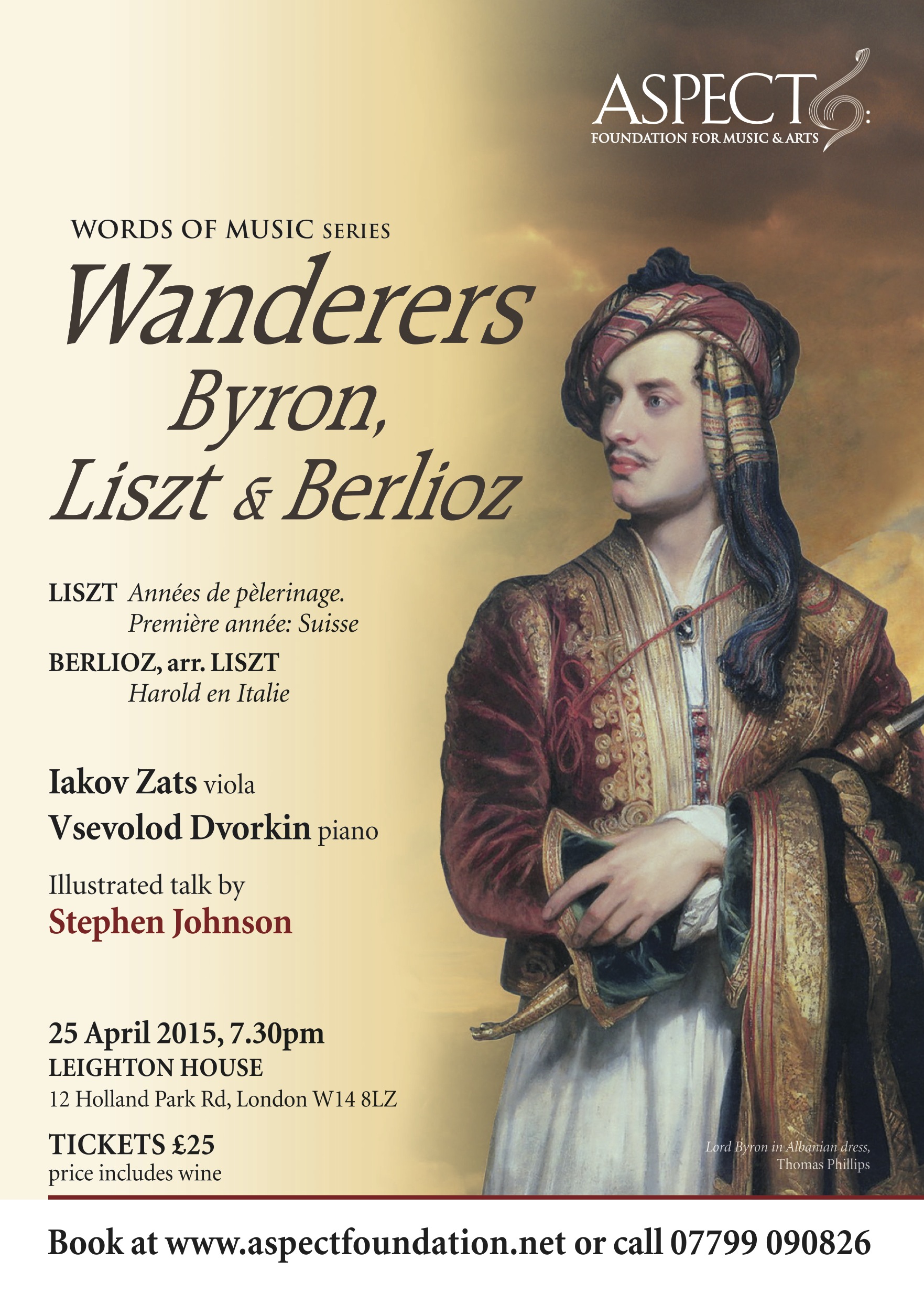
WANDERERS: BYRON, LISZT and BERLIOZ

The Romantic Age was a good time to be a sensitive, lonely misfit. After the success of Goethe and Byron’s writings, young men – and occasionally young women – dreamed of cutting their ties with cosy bourgeois security and wandering freely, searching for some kind of spiritual truth that might give purpose to their being. Not all of them found it: for some, the truth lying in wait was only painful disillusionment. Others, however, realised that, as Marianne Moore put it, ‘the cure for loneliness is solitude’. Franz Liszt’s first set of Années de pèlerinage (Years of Pilgrimage) records what he found on his travels in Switzerland, the ‘images’ that ‘stirred deep emotions in my soul’. Berlioz’s symphony Harold in Italy (arranged by Liszt) shows Berlioz following in Harold’s footsteps, to the point where he could say, with Byron, ‘I live not in myself, but I become portion of that around me’. 

Photos                                                                            25 April 2015 


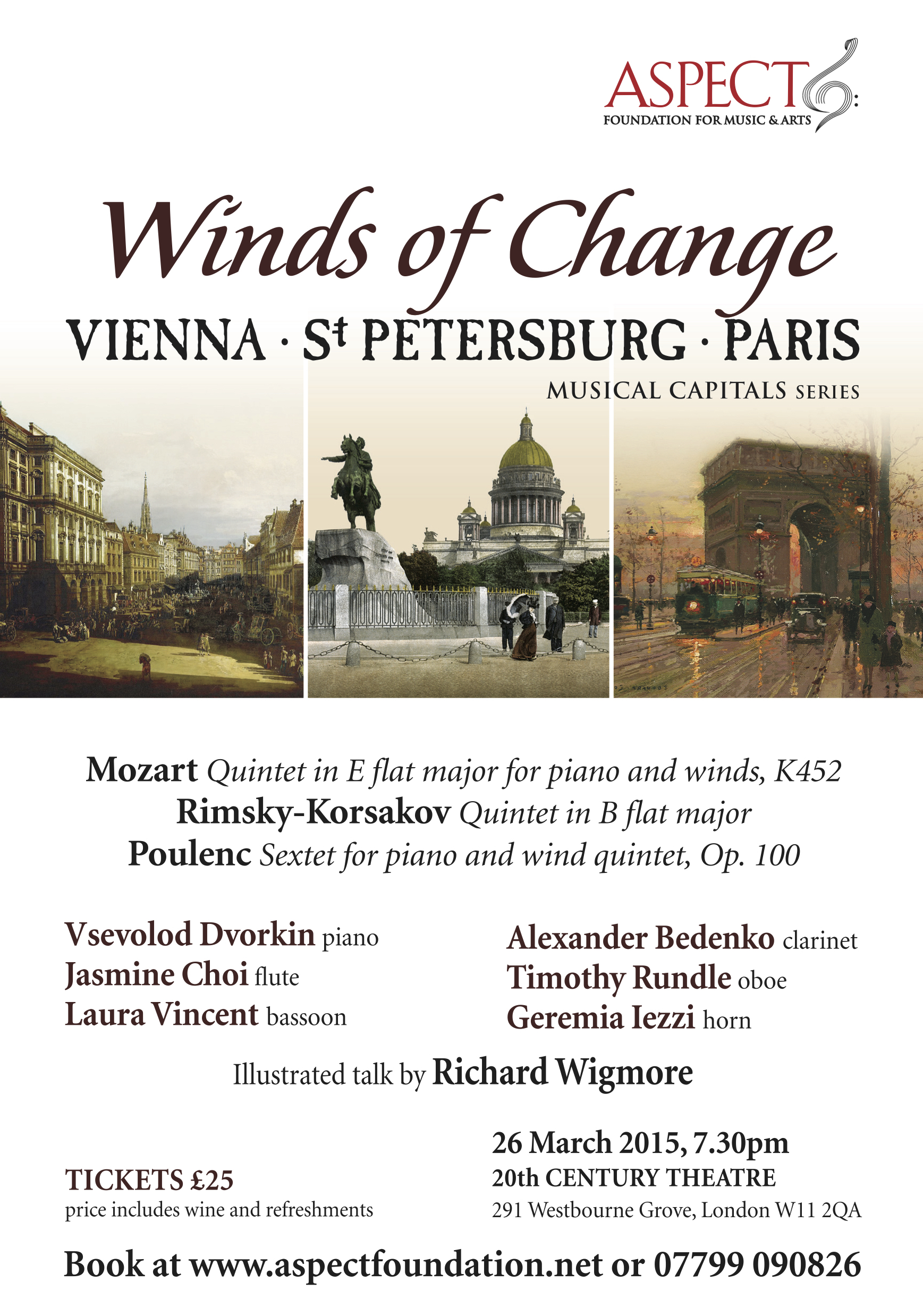
WINDS OF CHANGE: VIENNA, St PETERSBURG, PARIS

Three masterpieces of the chamber wind repertoire by three epoch-making composers. Mozart’s sublime Quintet, K452, in his own opinion ‘… the best work I ever composed’, combines the essence of Viennese Classicism with the composer’s distinctive operatic magnificence. Rimsky-Korsakov, ‘chief architect’ of St Petersburg’s ‘Mighty Handful’, brought his experience as an Inspector of Russia’s naval bands to bear on his writing for winds and brass. His exuberant and brilliantly colourful Quintet in B flat is all too rarely heard. The concert ends with Poulenc, leading member of ‘Les Six’, the unconventional group of composers active in 1920s Paris. All his flamboyant wit and wistful poetry is captured in the Sextet, Op. 100. 

Photos    Videos                                                                        26 March 2015 


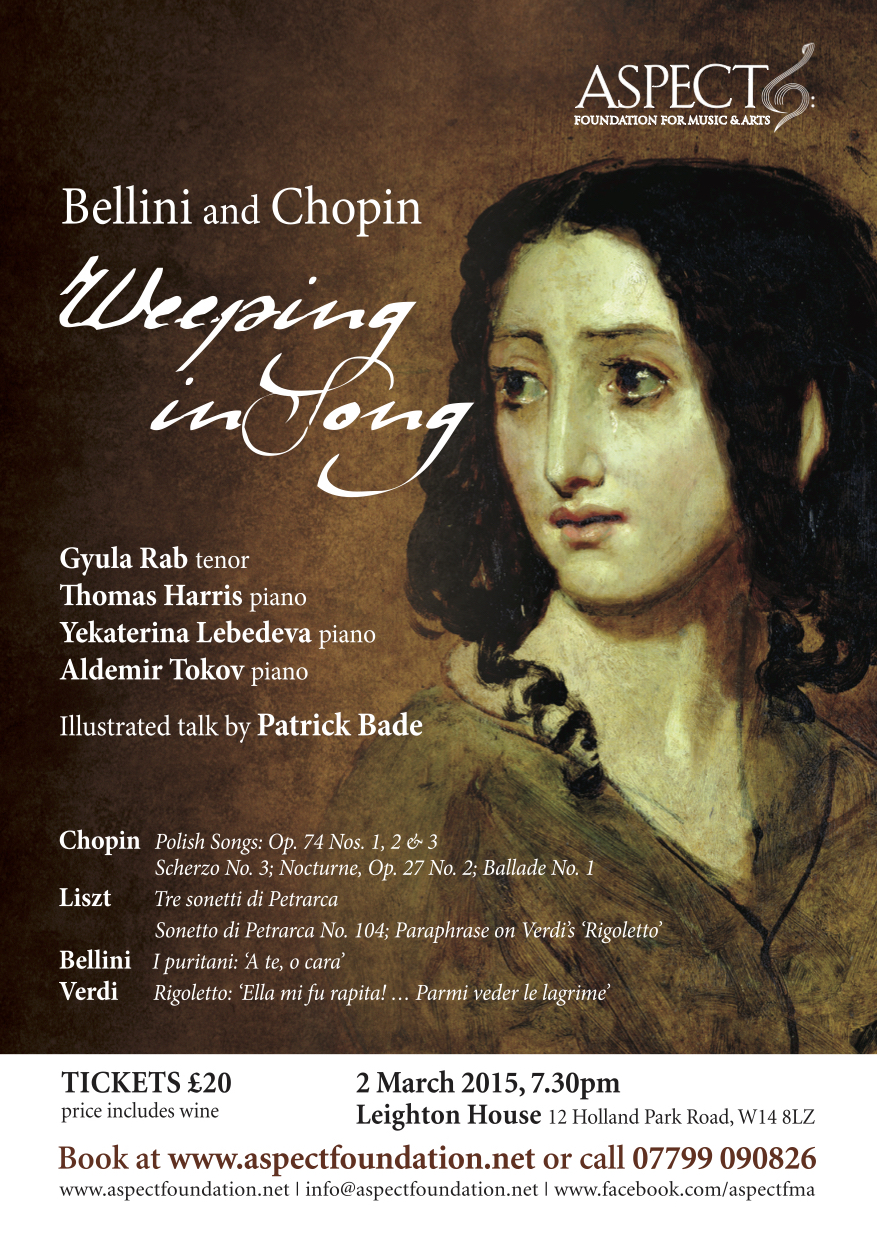
BELLINI AND CHOPIN: WEEPING IN SONG

It was inevitable that the Sicilian Vincenzo Bellini (1801–35), whose musical ideal was ‘weeping in song’, and the Polish-born Fryderyk Chopin (1810–49), who understood better than any other composer how to make the piano weep and sing, should sincerely admire one another. Both men died at an early age, but their quintessentially Romantic music, characterised above all by extended and expressive melodic lines, continued to exert an influence throughout the nineteenth century– one that can be heard in the work of such disparate composers as Verdi, Liszt and Wagner, and even in the later, verista operas of Giordano, Cilea and Orefice. This concert, in the sympathetic surroundings of Leighton House, will explore both the relationship between Chopin and Bellini and the far-reaching impact of their music.

2 March 2015


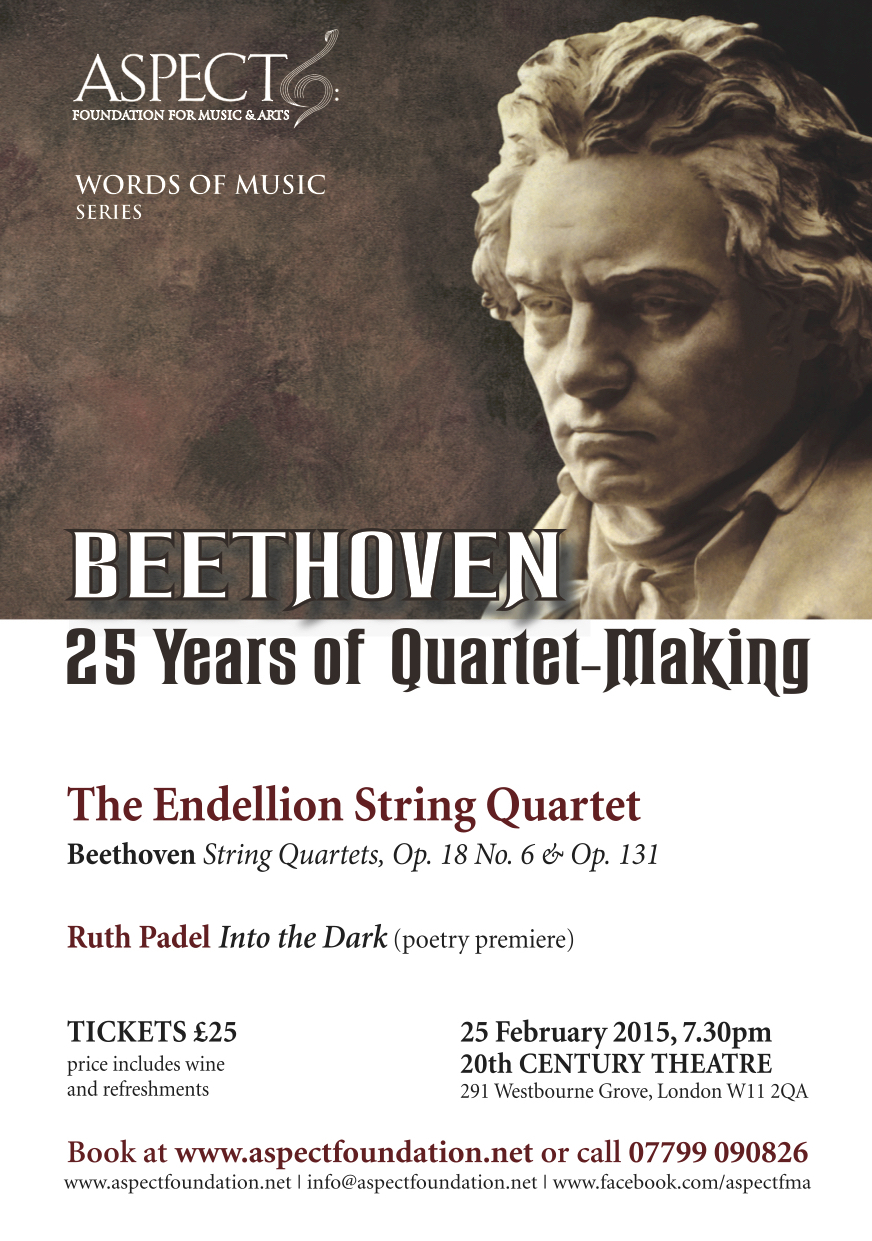
BEETHOVEN: 25 YEARS OF QUARTET-MAKING

This concert features one of Beethoven’s earliest string quartets and one of his last. His Opus 18 was published in 1801, and No. 6 is a high-spirited and warm-hearted piece. Twenty-five years later, the composer completed his Opus 131: seven movements to be played without a break. Although the quartet received a mixed response from his contemporaries, Beethoven himself thought it his most perfect single work. What was going on in his life when he wrote it? How did this lonely, haunted man perfect his extraordinary journey into the quartet form, one full of conversation, human togetherness, social harmony and integration? How did he move from the Classical balance of Op. 18 to the grandeur, avant-garde daring and unspeakable sorrow of Op. 131?

Photos                                                                              25 February 2015


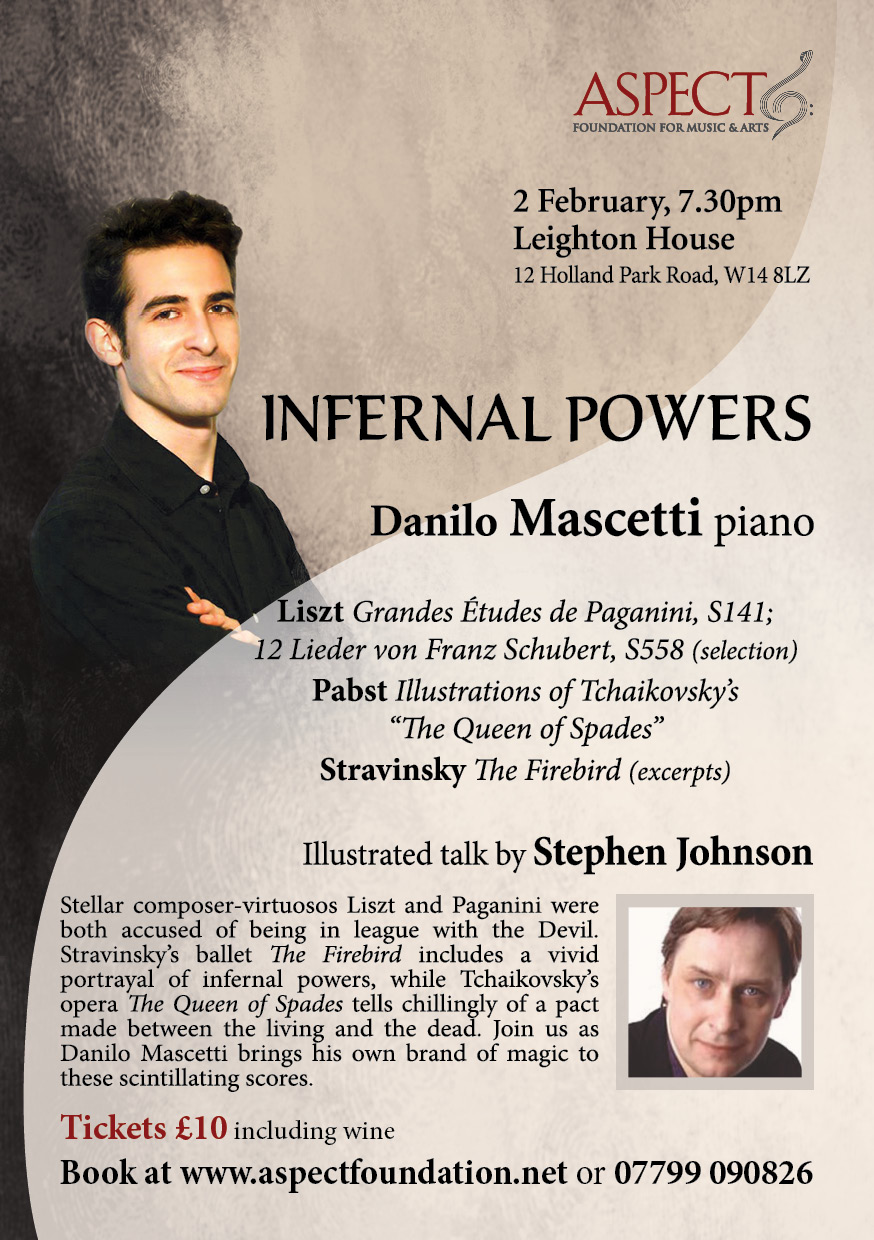
INFERNAL POWERS

Stellar composer-virtuosos Liszt and Paganini were both accused of being in league with the Devil. Stravinsky’s ballet The Firebird includes a vivid portrayal of infernal powers, while Tchaikovsky’s opera The Queen of Spades tells chillingly of a pact made between the living and the dead. Join us as Danilo Mascetti brings his own brand of magic to these scintillating scores.

Photos         Videos                                                     2 February 2015

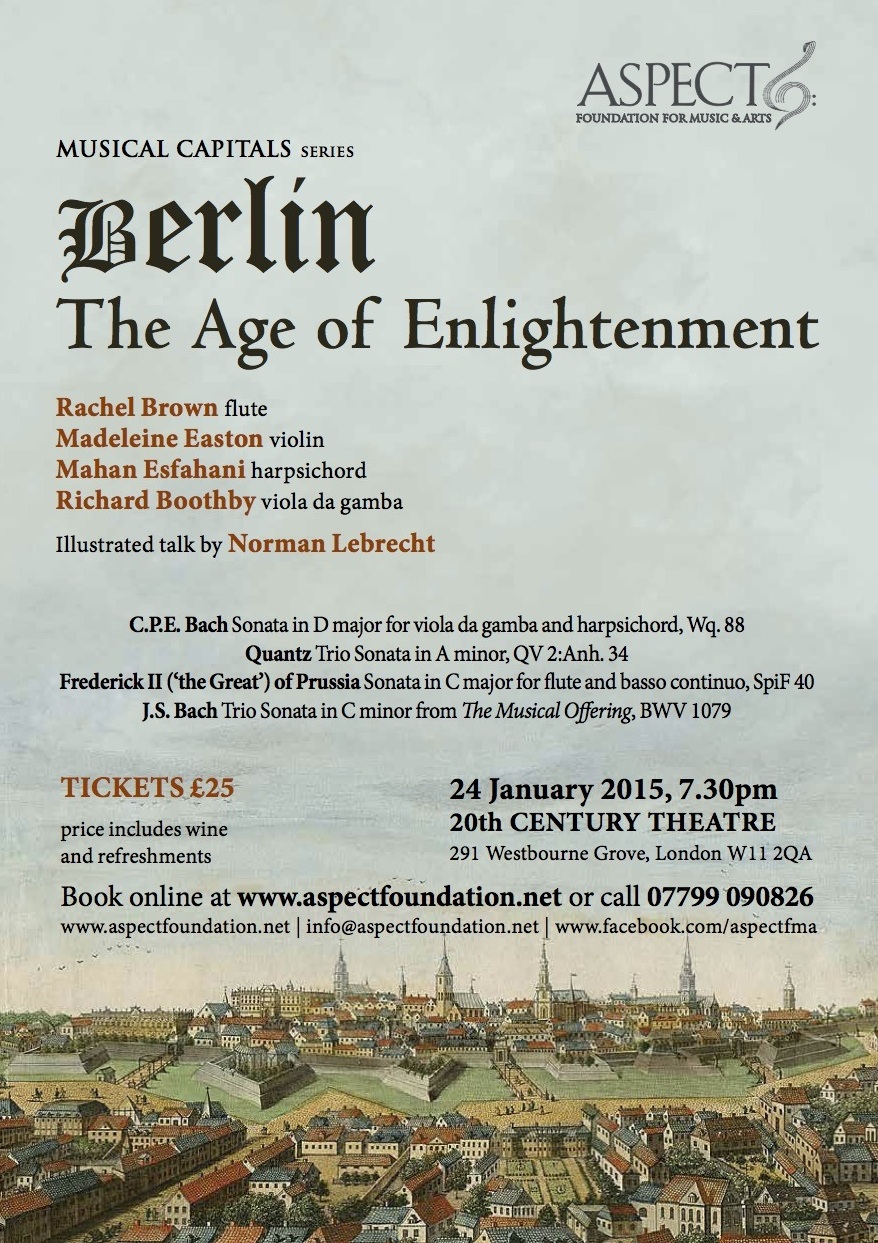
Musical Capitals series


BERLIN:
THE AGE OF ENLIGHTENMENT

What makes Berlin a musical city? Is it the fact that it boasts ‘the world’s finest orchestra’, or the greatest number of world-class opera houses in one city, or the most diverse alternative music scene? Is it, perhaps, a combination of the three? Or maybe none of the above? In thist Aspect concert, Norman Lebrecht will discuss what it takes to be a musical capital and examine how Berlin went from garrison town to cultural hub. The history is more complicated than it seems. Some would argue that Berlin only achieved centrality thanks to its Wall. Mahan Esfahani explores Berlin’s musical origins from the roots up: from Frederick the Great’s musical consolations, the musicians and great minds that he gathered around him, and those he drove away. Where was J.S. Bach when Germany really needed him?

Photos           Videos                                                     24 January 2015

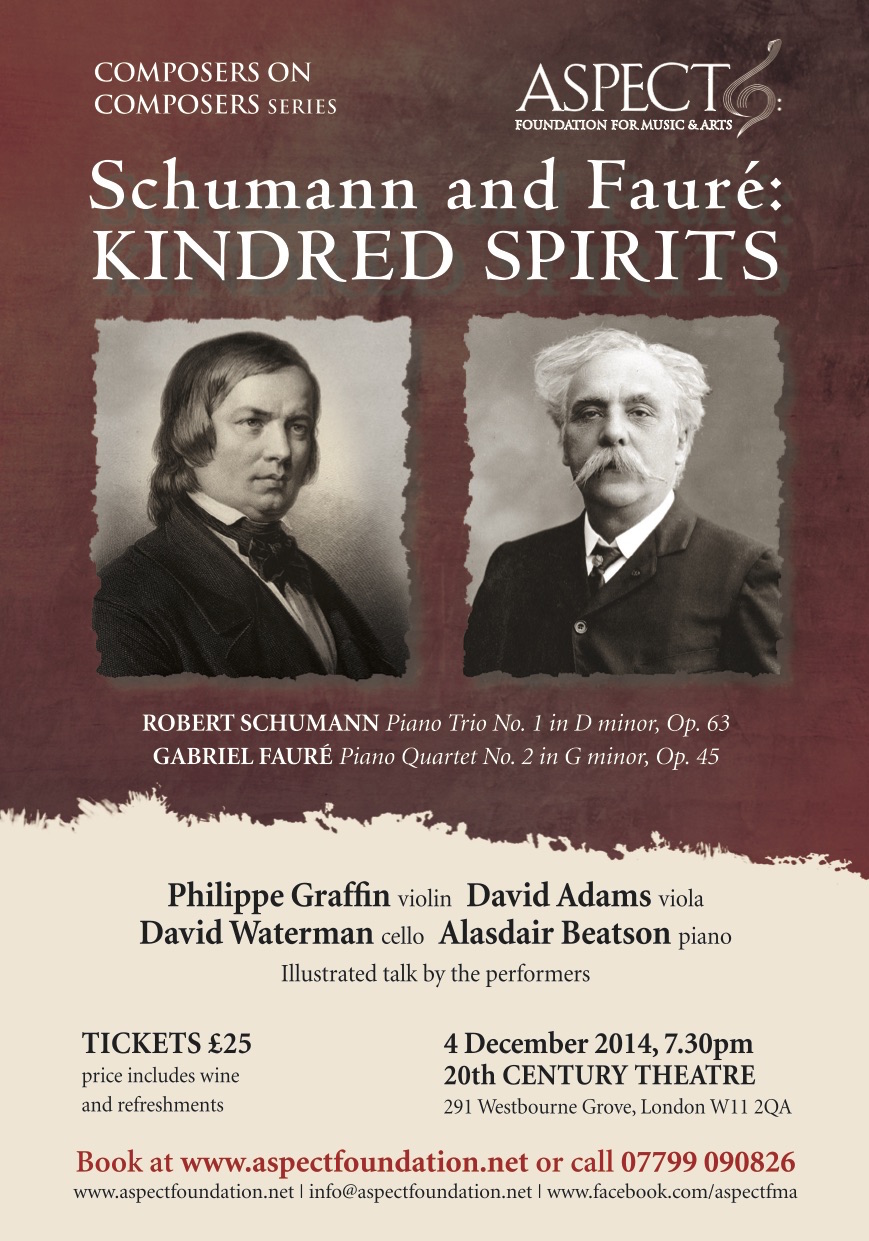
Composers on Composers series


SCHUMANN AND FAURÉ : KINDRED SPIRITS
 

Fauré came of age in a France fighting for its cultural identity. His own admired teacher Saint-Saëns led the charge in trying to create a non-Germanic music tradition, aided by Chabrier and D’Indy, then Debussy and Ravel. But it was also Saint-Saëns who introduced the young Fauré to the piano music of Schumann. A century later, Schumann’s music, alone among the German Romantics, sits naturally alongside French music, and finds a special resonance in Fauré’s own art, sharing its fluidity, inwardness and subtlety. Here, distinguished musicians Philippe Graffin, David Adams, David Waterman and Alasdair Beatson illustrate the musical links between these two elusive artists, performing Schumann’s intense D minor Trio, and Fauré’s Second Piano Quartet, a work of rare, ecstatic expression.

Photos           Videos                                                    4 December 2014

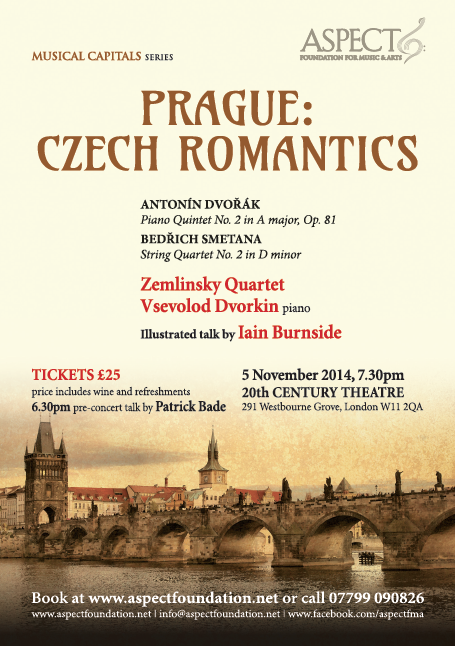
Musical Capitals series


PRAGUE: CZECH ROMANTICS

Smetana gave voice to the desire for independence of his fellow Czechs, so long yoked under the Habsburg Empire. His quartets, however, are a world away from his triumphantly nationalist operas and tone poems: in them we encounter the fevered imagination of an artist fighting for his sanity. Smetana’s example inspired his compatriot Dvořák to bring Bohemian and Moravian elements into his own warmly vivacious chamber music, creating an outpouring of dance and song. In this concert, broadcaster and pianist Iain Burnside looks at the emergence of a new nationalist identity in the rising city of Prague as it cast off its Germanic traits and, together with the Zemlinsky Quartet, explores the light and dark sides of these two great Romantic composers.

Photos           Videos                                                   5 November 2014

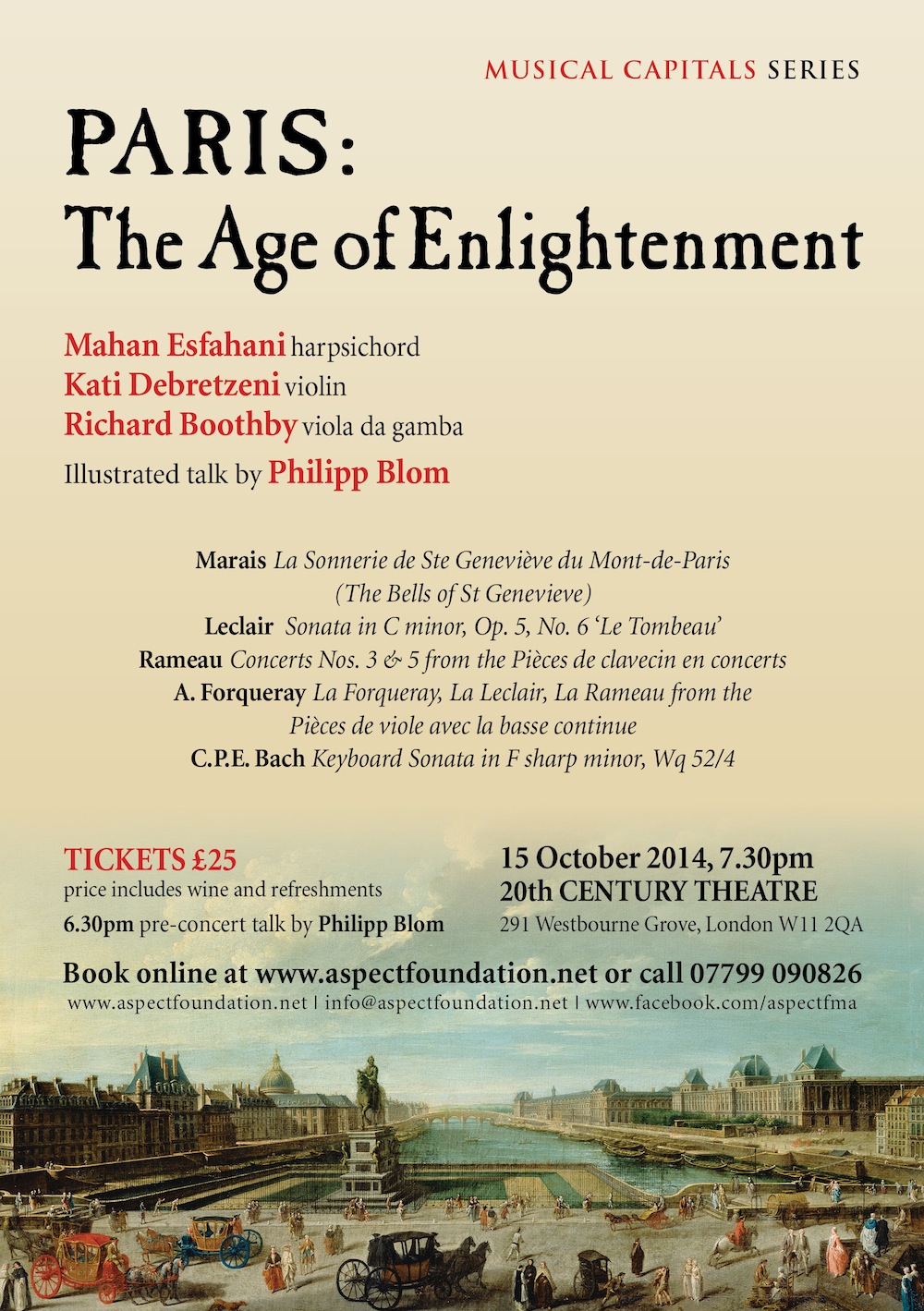
Musical Capitals series


PARIS:
THE AGE OF ENLIGHTENMENT

Paris circa 1770: home to the brilliant philosopher, writer and chief editor of the Encyclopédie Denis Diderot ¬– one of the most courageous advocates of a radical, godless Enlightenment. He and other like-minded intellectuals would meet at the salon of Baron d’Holbach to discuss how best to lead lives of passion and empathy, to indulge in fervent debates about opera, and to listen to chamber music – Diderot himself saw music as a direct route into people’s hearts and minds. In this concert, historian Philipp Blom, in company with harpsichordist Mahan Esfahani and friends, will investigate Diderot’s close relationship with music, interspersing period-instrument performances of chamber works by Marais, Rebel, Rameau, Forqueray and C.P.E. Bach – compositions that resonated through his life – with readings from his letters, essays and novels.


Great Muses series


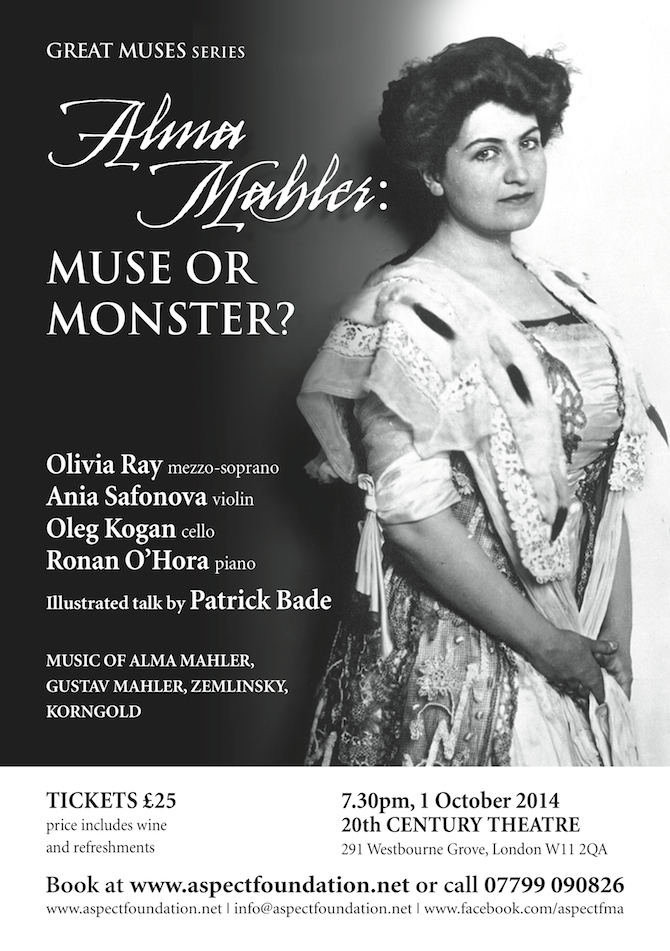
ALMA MAHLER: MUSE OR MONSTER?

It was the litany of lovers and husbands in what he described as ‘the juiciest, spiciest, raciest obituary that it has ever been my pleasure to read,’ that inspired Tom Lehrer’s famous song about Alma Mahler, whose lyrics include the lines «Her lovers were many and varied, from the day she began her beguine. There were three famous ones whom she married, and God knows how many between.» Alma Schindler Mahler Gropius Werfel was not one of those celebrated beauties who retained her allure into old age. Colour film footage of her from the 1950s presents a raddled and formidable matron. In photographs taken of her in her prime, we can admire her flawless profile and magnificent bosom. Were these features enough to fascinate a small army of gifted men? In an evening of chamber music and songs, including some by the lady herself, we shall explore the enigma of Alma Mahler and the impact she had on the culture and music of her time.

Photos           Videos                                                          1 October 2014

Words of Music series


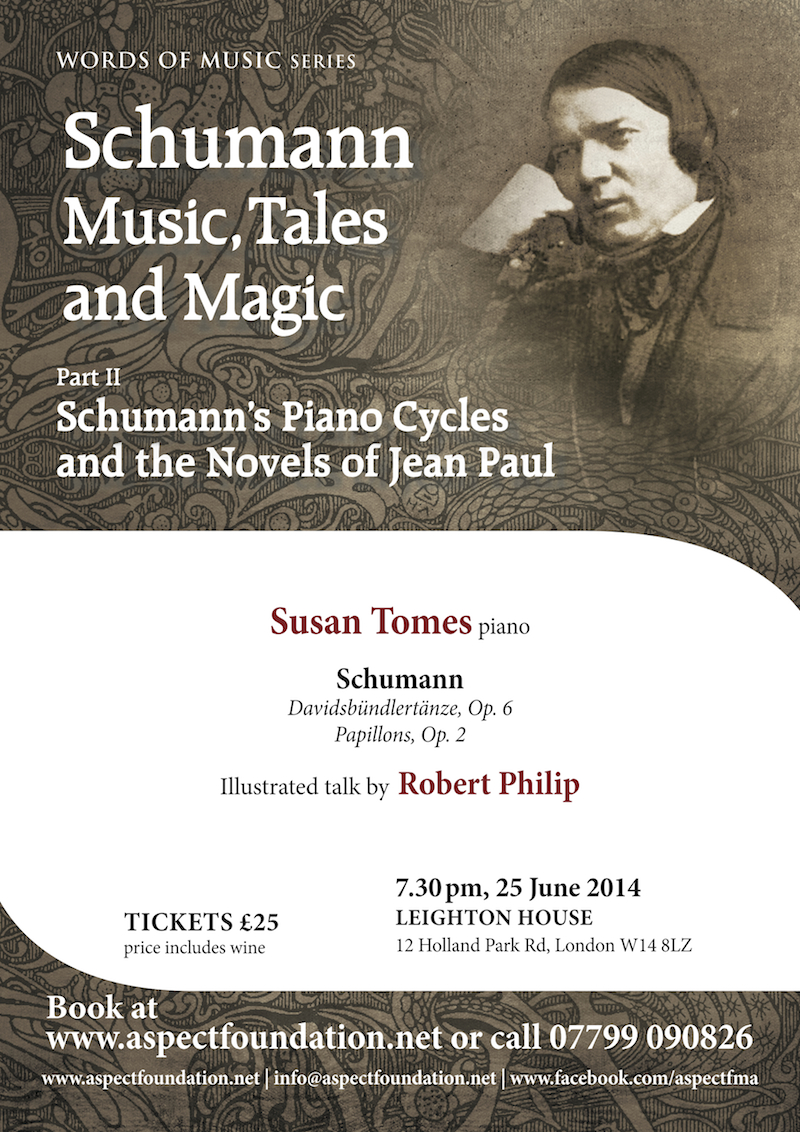
MUSIC, TALES AND MAGIC. Part II
Schumann and the Novels of Jean Paul

The son of a bookseller and publisher, Robert Schumann was inspired as much by literature as by music. Of all the authors he esteemed, his favourite was Jean Paul. He once wrote to a friend that, from Jean Paul ‘I learned more about counterpoint than from my music teacher’. What was it about this (now unfashionable) writer that so appealed to the young Schumann? And what was the nature of the ‘counterpoint’ that he learned from him? The music presented in this programme is intimately connected with Jean Paul, and in particular with his novel Flegeljahre (The Awkward Age). Between the two Schumann works, we will explore how the composer brought the fantasy of Jean Paul together with his own emotional experience (particularly his forbidden relationship with Clara Wieck) to develop a unique character as musician and writer.

 Photos           Videos                                                          25 June 2014

Great Muses series


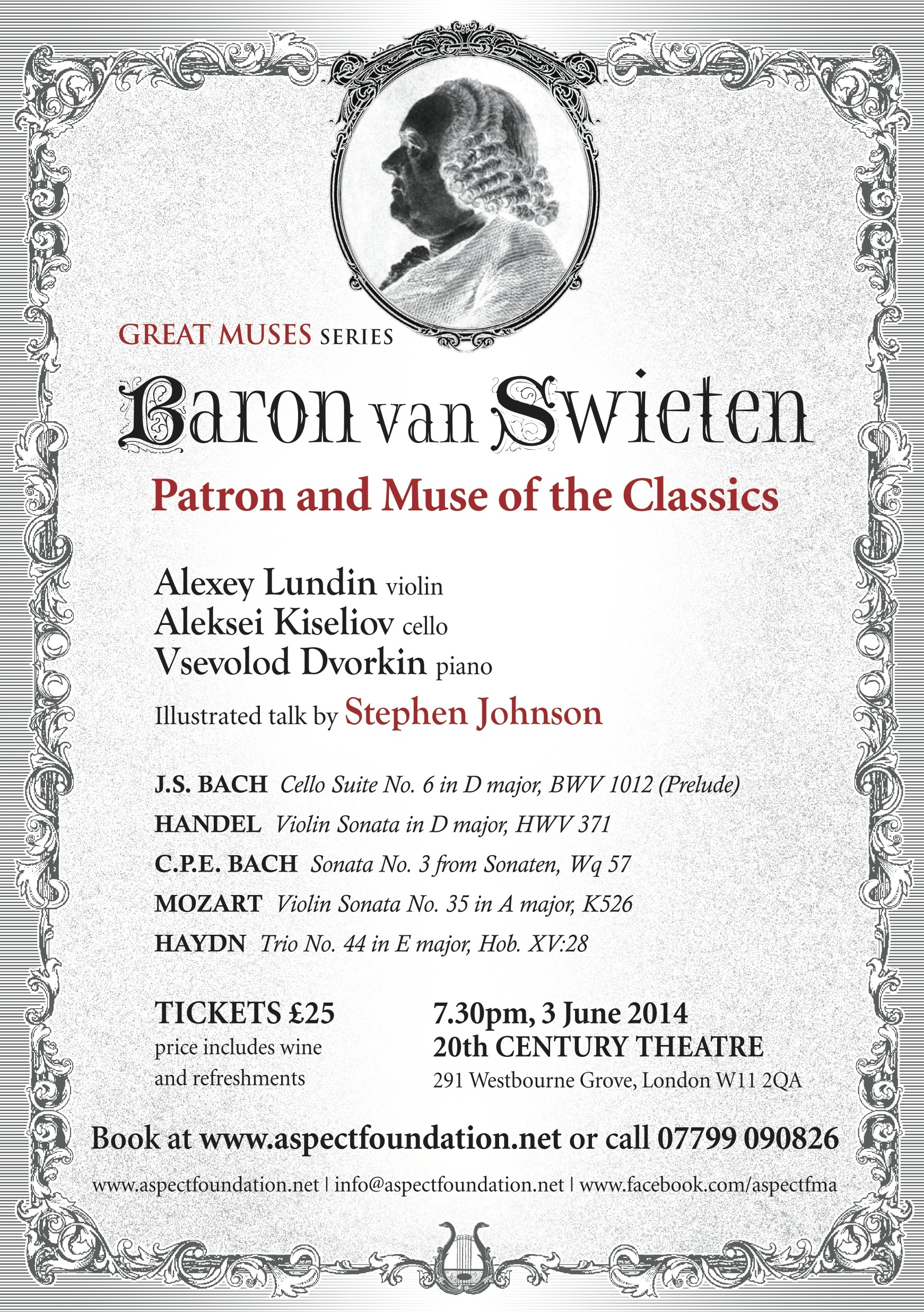
BARON VAN SWIETEN
Patron and Muse of the Classics

In most music history books he’s a shadowy figure at best. By all accounts, Baron Gottfried van Swieten was a mass of contradictions. Pompous in his dealings with musicians, acutely, even comically aware of his own minor aristocratic status, he could also be generous and loyal. He may have looked down his nose at Haydn and Mozart, but for their work he had nothing but respect. And without him, key works by them, and by Beethoven, would have sounded quite different. Which means that their influence on the later development of western classical music would have been very different too. Although his own efforts at composing were unimpressive, van Swieten’s recognition of the talents of others was unusually insightful. He felt he was offering these great composers ‘food for the spirit and for the heart’, and such masterpieces proved him right.

Photos           Videos                                                        3 June 2014

Words of Music series


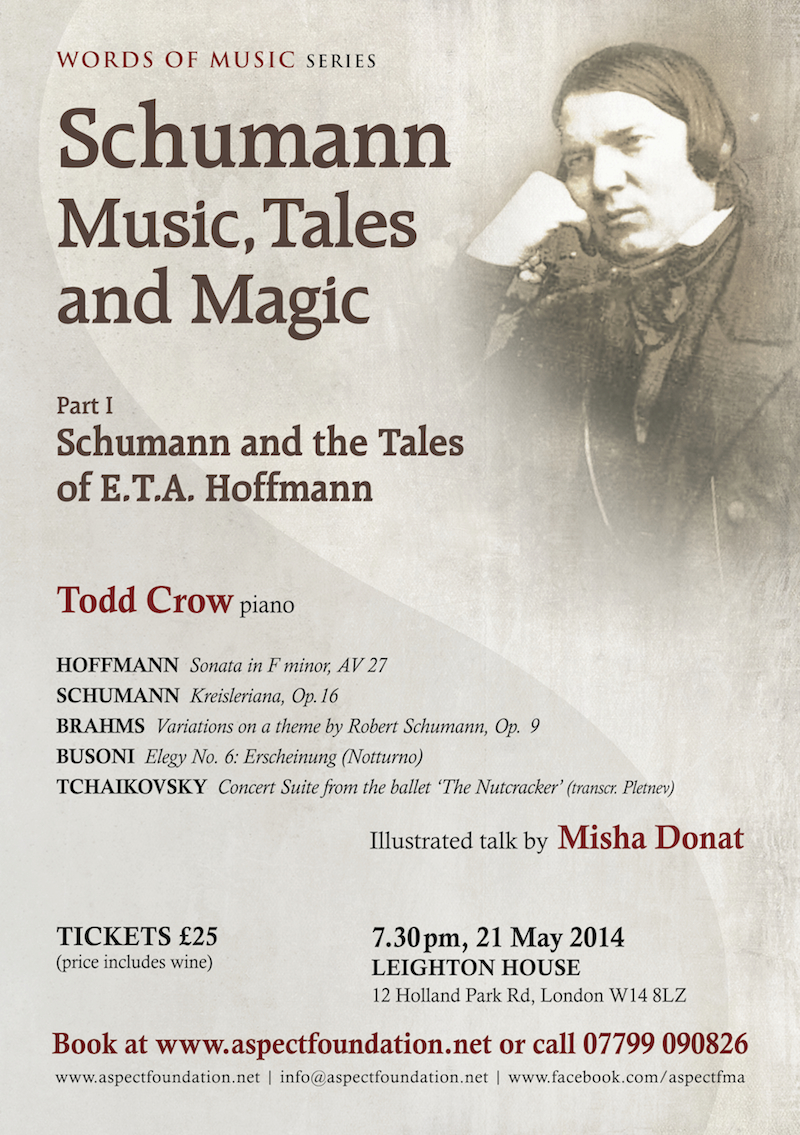
MUSIC, TALES AND MAGIC. Part I
Schumann and the Tales of E.T.A. Hoffmann

‘One hardly dares breathe when reading Hoffmann,’ said Schumann of the great writer in whose work the borderlines between dream and reality, art and life, the natural and the supernatural so often become blurred. From Hoffmann, Schumann borrowed the titles of some of his best-known piano pieces – Kreisleriana, Fantasiestücke, Nachtstücke – while the young Brahms signed some of his early compositions ‘Kreisler Junior’, in homage to the fictional musician created by the author. Hoffmann’s tales inspired ballets by Tchaikovsky (The Nutcracker) and Delibes (Coppélia), as well as operas by Offenbach, Busoni (Die Brautwahl) and Hindemith (Cardillac). Hoffmann himself was also a composer, and his proto-Romantic opera Undine was praised by Weber. His influence as a writer, meanwhile, was felt as far afield as France, Russia and America, those who fell under his spell including Baudelaire (for whom he was simply ‘the divine Hoffmann’), Balzac and Maupassant, as well as Dostoevsky, Pushkin and Gogol, and Edgar Allan Poe.

Photos                                                                    21 May 2014

Musical Capitals series


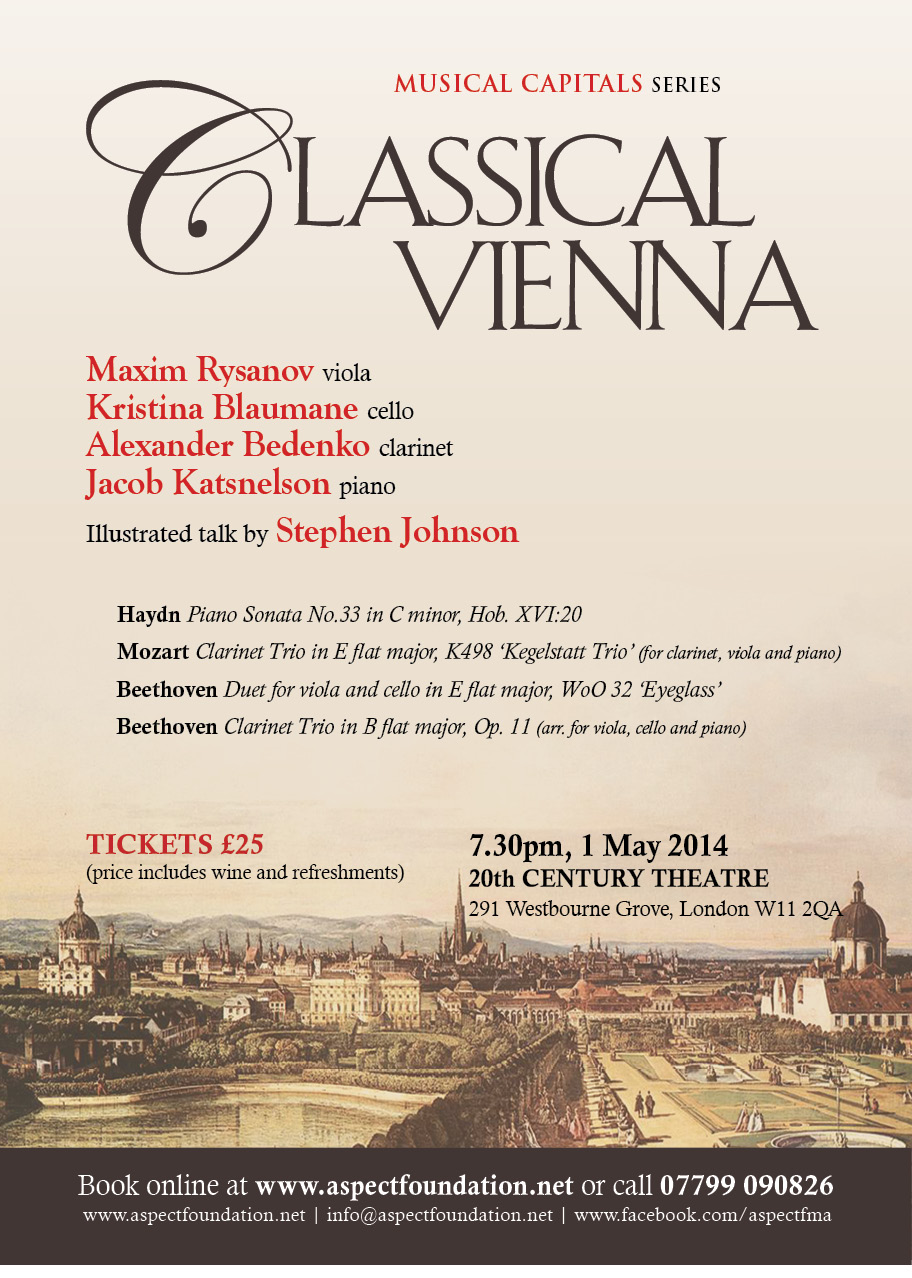
CLASSICAL VIENNA

Today, Haydn and Mozart are routinely labelled ‘Classical’. But for a brilliant younger contemporary of theirs, the writer, composer and critic E.T.A. Hoffmann, they were ‘Romantics’, and Beethoven was their natural successor. What we now call the Classical Era was an age of ferment and transition. This was also the so-called Age of Enlightenment, in which intellectuals of many disciplines were challenging the authority of the throne or the pulpit, and arguing that truth could only really be found by independent enquiry, and tested by discussion with similarly independent minds. The first stirrings of Romanticism, revolutionary thinking, the spirit of courageous enquiry and delight in disputation. But the ‘Classical’ label is not simply wrong. This was an age in which new musical forms were being perfected, in which Sturm und Drang was countered by an instinct for balance, elegance of proportion. The paradox of Vienna is also the paradox of its music.

Photos           Videos                                                       1 May 2014

Words of Music series


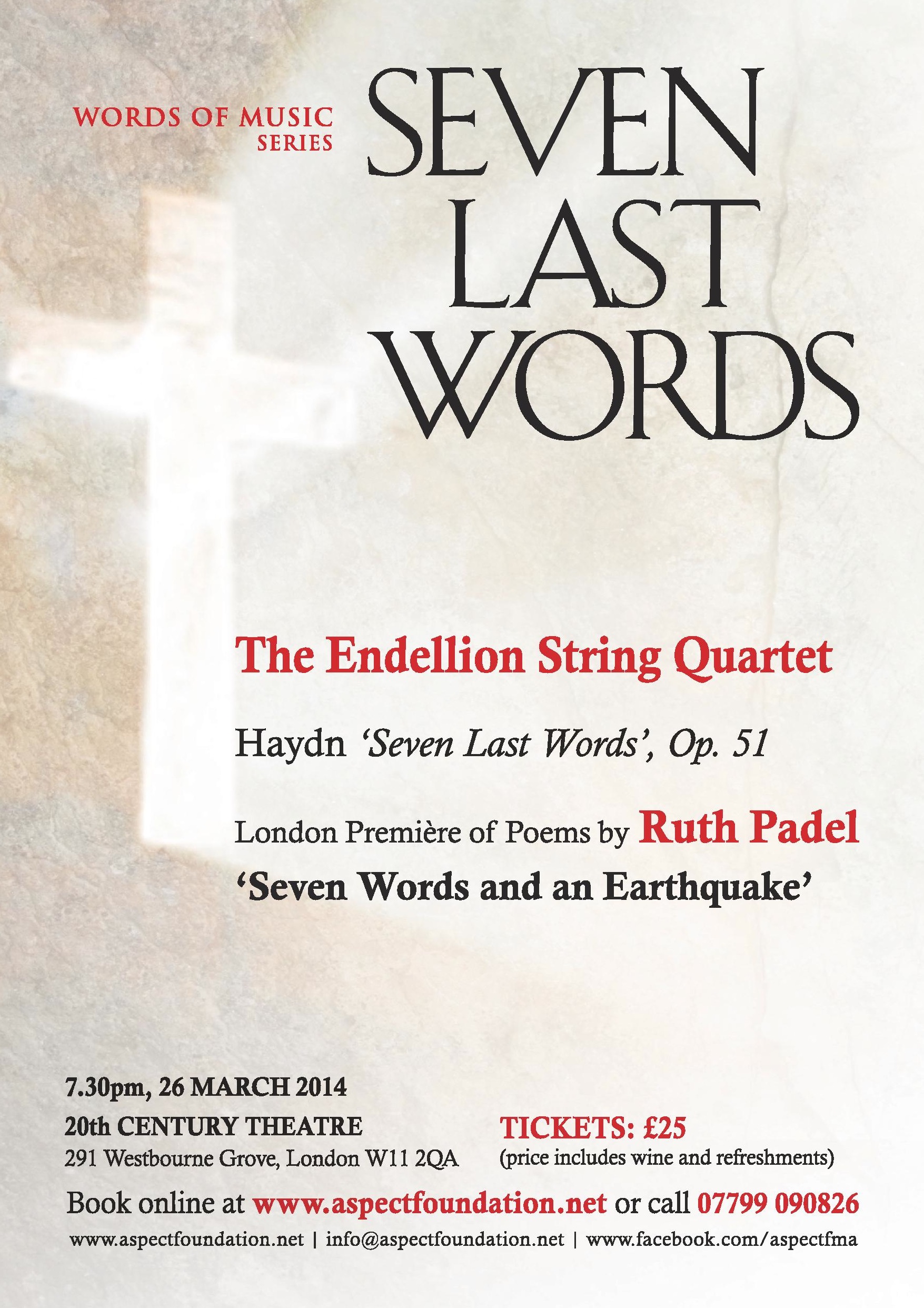
SEVEN LAST WORDS 

On Good Friday 1787, in the great Baroque cathedral of Cádiz, music by Joseph Haydn was performed during ten-minute intervals between the bishop’s meditations on the Seven Last Words of Christ on the Cross. These Last Words refer to seven short utterances made by the dying Christ, taken from the Gospel stories of the Crucifixion, and Haydn wrote his music as a personal response to each of them. In this concert, we hear interspersed between Haydn’s movements not sermons, but poems, written and read by Ruth Padel in tribute to the interrelations, and tensions, created by the composer between word and music. Each poem ends with the Word to which the ensuing music then responds. This first London performance of Padel’s haunting poems offers a uniquely tangible and contemporary vision of a historic scene, as a world-renowned string quartet and a multi-award-winning poet take us on an emotional journey which begins by attending to the needs of others – Forgiveness, Comfort and Relationship – and progresses through Abandonment and Distress to culminate in Fulfilment and Reunion.

                                           
 Photos                                           26 March 2014

Words of Music series


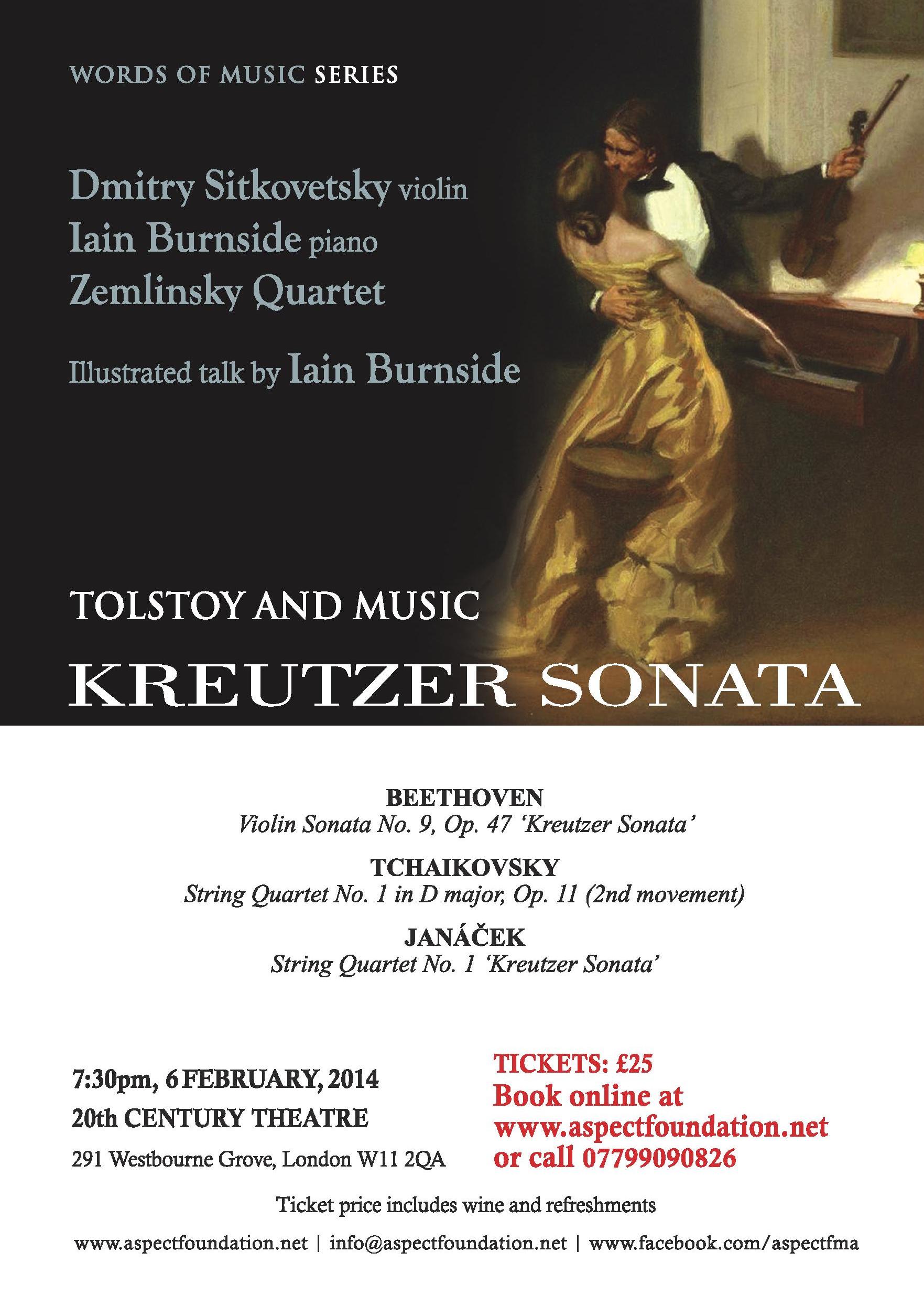
TOLSTOY AND MUSIC: KREUTZER SONATA 

Beethoven’s ‘Kreutzer Sonata’ for violin and piano (dedicated to Rodolphe Kreutzer, a French violinist who never performed it) is the centerpiece of Tolstoy’s disturbing and controversial novel, ‘The Kreutzer Sonata.’ The novel in turn inspired the Czech composer, Leoš Janáček, to write his eponymous, intense and feverish first string quartet. Join us as we explore the unique connections between music and literature, and witness music become, in Tolstoy’s words, ‘…a shorthand of feelings.’ It's more than a concert…

 Photos      Videos                          6 February 2014

Musical Capitals series


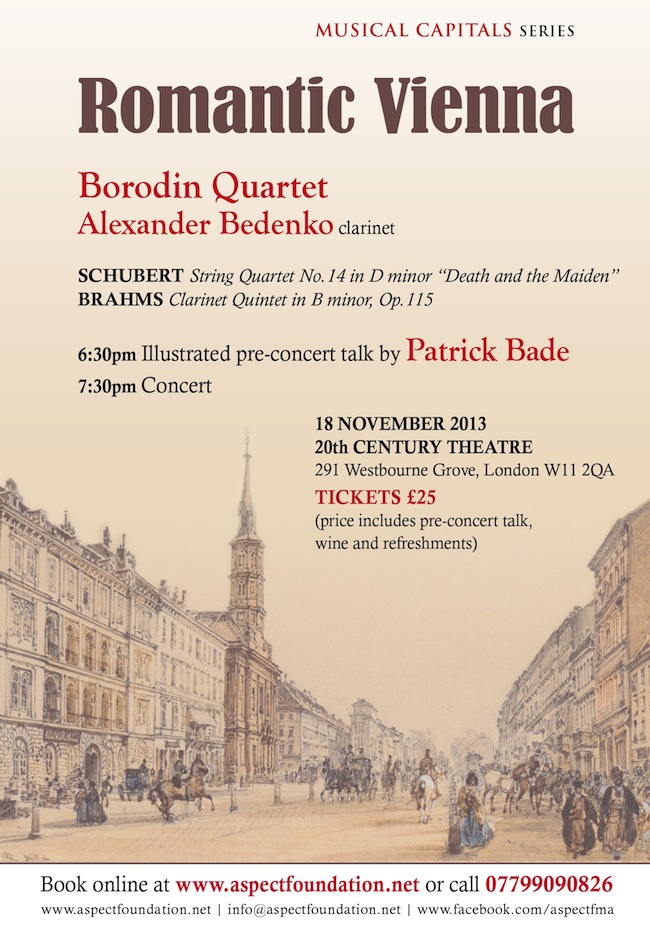
ROMANTIC VIENNA: FROM DAWN TO DUSK 

From the time of Gluck in the mid-eighteenth century to that of Mahler and Schoenberg in the early twentieth, Vienna was the capital of capitals as far as music was concerned. If a composer could make it there, he truly could make it anywhere. Amongst the composers of genius attracted to the city were Haydn, Mozart, Beethoven, Brahms, Richard Strauss and Lehar, not to mention such native sons as Schubert and Johann Strauss. In no other city was music quite so central to its life, or musical intrigues quite so poisonous! In our Romantic Vienna programme (the first of the three concerts devoted to Vienna) we shall be exploring the music and art of the Romantic period. We will present the music of Schubert and Brahms, the Romantic classics. Both Schubert and Brahms composed in the traditional forms established by the great classical Viennese trinity: Haydn, Mozart and Beethoven, but the content of their music is highly Romantic. While Schubert's music (like that of the later Beethoven) heralds the dawn of Romanticism, that of Brahms brings on the dusk.

 Photos         Videos                   18 November 2013

Words of Music series


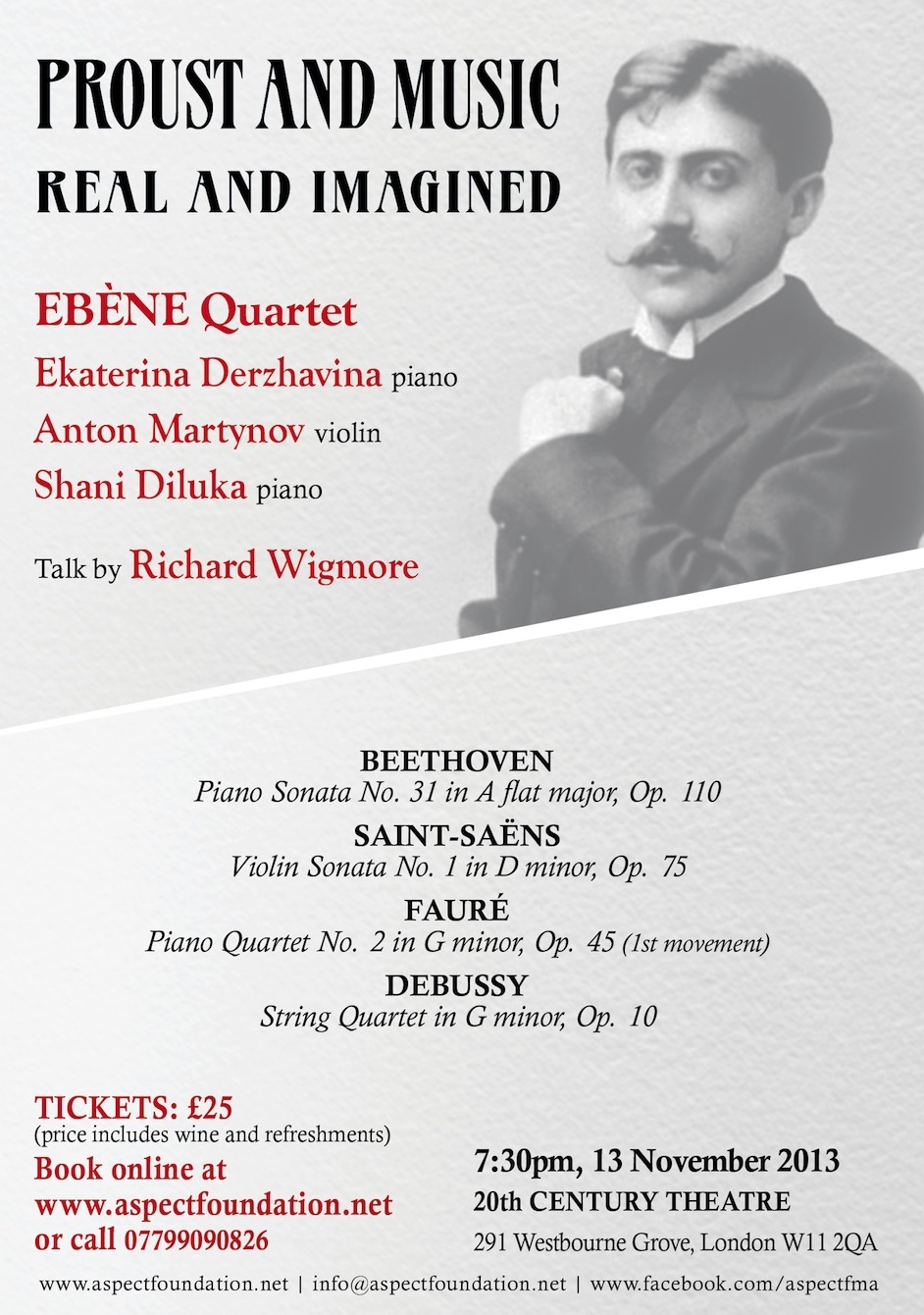
PROUST AND MUSIC: REAL AND IMAGINED 

Marcel Proust was one of the most musically responsive of writers. Hypersensitive and hyper-fastidious, he once wrote to his friend Gabriel Fauré that he was ‘intoxicated by his music’. Fauré in turn became one of the models for the composer Vinteuil in Proust’s À la recherche du temps perdu. Yet as Proust revealed, the inspiration for the ‘petite phrase’ associated with Swann’s love for Odette in the novel was not Fauré’s, but the ‘motto’ theme that pervades Camille Saint-Saëns’ Violin Sonata in D minor.
Join us as we explore music associated with Proust in a programme that ranges from late Beethoven (one of the writer’s dearest loves) via the charming, rarely heard Saint-Saëns violin sonata, to the first movement of Fauré’s Piano Quartet in G minor inspired by the composer’s childhood memories (Proust would have approved), and finally, to Debussy’s revolutionary String Quartet of 1893, Proust’s favourite work by his favourite living composer.

Photos      Videos                                            13 November 2013
 

Great Muses series


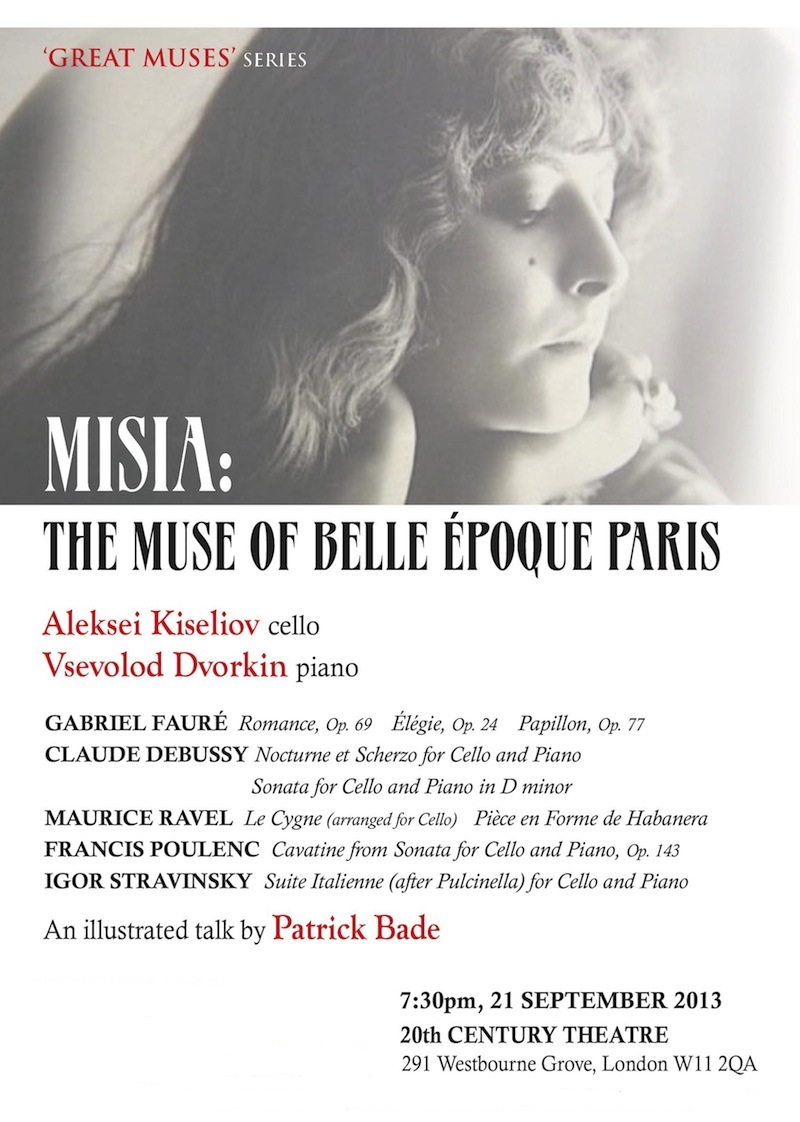
MISIA: THE MUSE OF BELLE ÉPOQUE PARIS

Misia Sert, née Godebska (1872-1950), was a muse and a patron to some of the most famous musicians, artists and writers from the Belle Époque 1890s through the 1930. According to Paul Morand, «She excited genius… through nothing but the vibration of her being.» A talented musician in her own right, she studied piano under the composer Gabriel Fauré (1845-1924). An enthusiastic performer of Beethoven, Schubert and Chopin, she was passionate about Debussy and Ravel. In the twentieth century, Misia’s musical tastes turned towards a new aesthetic represented by Satie, Stravinsky, Auric and Poulenc. One of the most prolifically painted women of her time, Misia was portrayed by Vuillard, Bonnard, Vallotton, Renoir, Toulouse Lautrec and many others. Join us to as we present the music of Belle Époque and beyond; become a part of our encounter with Misia, a woman, who by virtue of her magnetic presence alongside artists of her time, became a muse and an arbiter of taste for several decades.

Photos    Videos                                      21 September 2013
 

Words of Music series


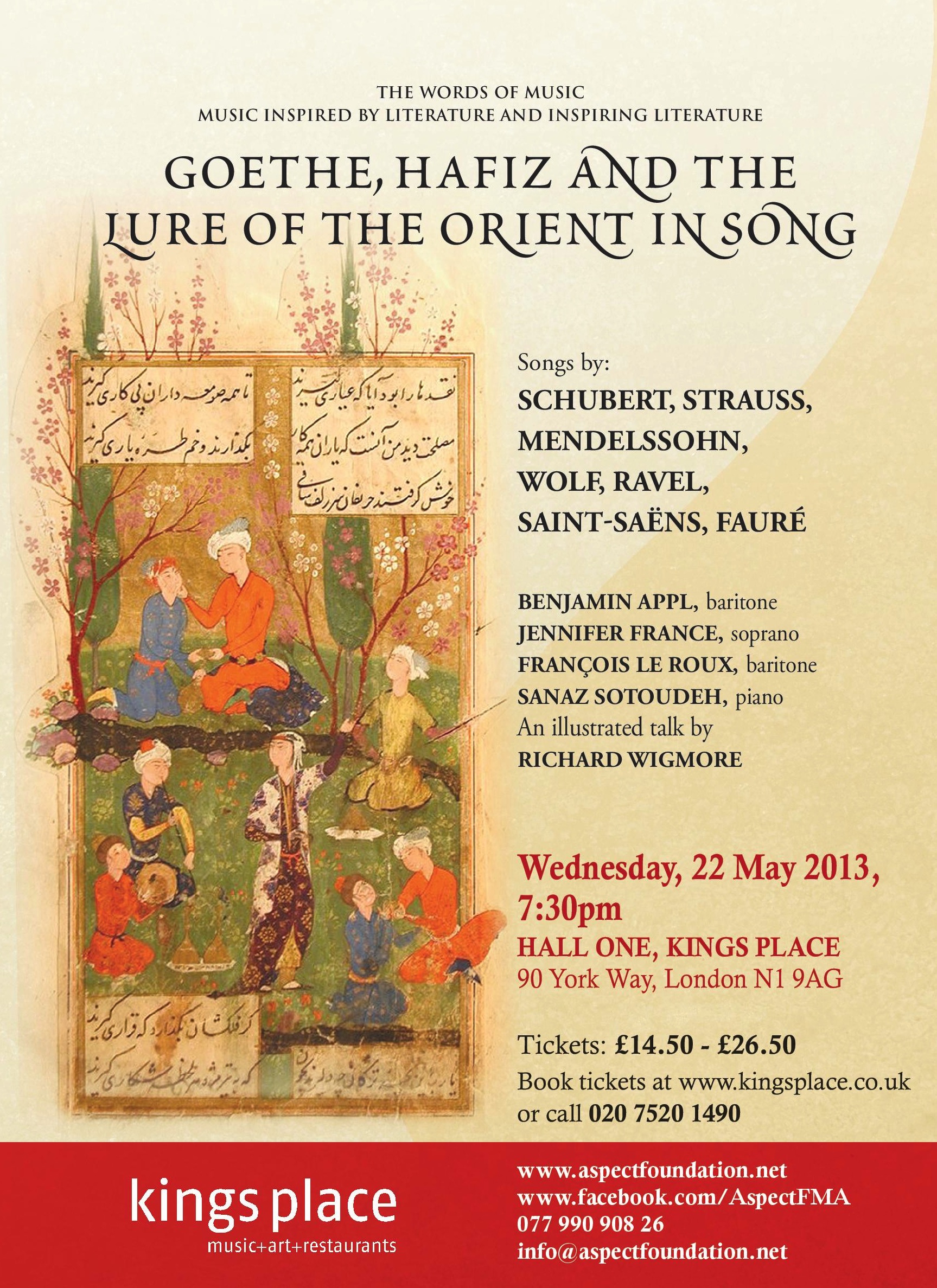
THE LURE OF THE ORIENT IN SONG

The great Goethe, when in his sixties, fell under the spell of Hafiz, the 14th century Persian poet. Hafiz’s poetry inspired Goethe to create the ‘West-Östlicher Divan’ – a collection of love poems, epigrams and drinking songs. Goethe’s verses in turn inspired composers such as Franz Schubert and Felix Mendelssohn, while poems of Hafiz were set to music by Hugo Wolf and Richard Strauss. Join us as we explore Europe’s century-long love affair with the Orient through poetry, painting and song.

Photos                                                                                       22 May 2013


Great Muses series


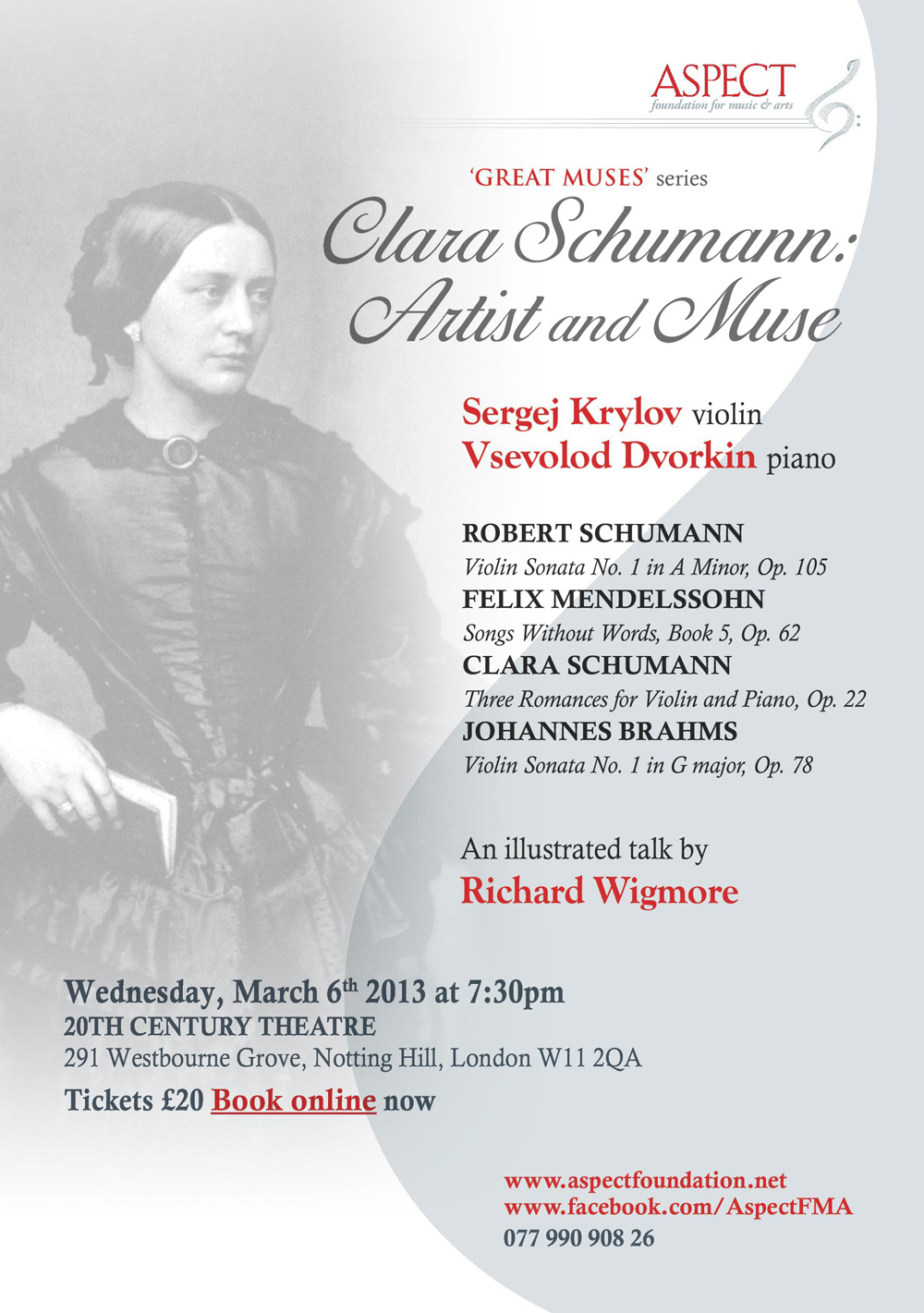
CLARA SCHUMANN: ARTIST AND MUSE

Clara Schumann (Clara Wieck) — virtuoso pianist and composer, wife of Robert Schumann, mother, teacher, friend and inspiration to many of her contemporaries — played many roles during the course of her life. She became one of the greatest performers of the century alongside Thalberg, Chopin, Rubinstein and Liszt, the latter dedicating both his 1838 and 1851 editions to her as one of the finest contemporary pianists. Clara was Schumann's muse and musical voice, creative partner and interpreter of his work. Clara was the inspiration and guide for much of the music of Brahms, who fell hopelessly in love with her as a young man. Along with Clara’s own music, this programme presents music composed by the men for whom she was friend, love, and inspiration. Join us to get a glimpse of the woman behind the Muse.                

Photos      Videos                                     6 March 2013


Music in Context series


TRANSLATING IMAGE INTO MUSIC: Seeing Through the Eye of the Composer

When we look at an image that inspired a certain piece music, do we see it in the same way a composer did? Can we detect a connection between the image and the resulting composition? Tonight we will try to answer these questions by listening to Mussorgsky, Liszt and Debussy and by looking at paintings by Mikalojus Ciurlionis, a Lithuanian composer (1875–1911) who has translated musical forms into images. Mussorgsky wrote his piano cycle Pictures at an Exhibition after viewing the pictures and design of this friend, Viktor Hartmann. Liszt’s Sposalizio and Il Penseroso were inspired by Raphael’s painting and by Michelangelo’s statue respectively. Debussy’s Estampes are musical images of the countries Debussy never visited. The music we will hear tonight is the composers’ translation of the images into sound – the music gained in this translation.                               

More info                                                                              1 December 2012

VIENNA — CITY OF DREAMS

Vienna

Vienna Fin De Siècle. The names of Sigmund Freud, Karl Kraus, Robert Musil and Hugo von Hofmannsthal come to mind along with Theodor Herzl, Gustav Mahler and Gustav Klimt. Despite political and social crisis, Vienna gave an impulse to incredible music and art. Tonight we will try to recreate the spirit of Viennese life of the late 19th early 20th Century thought the music of Erich Korngold, Alexander Zemlinsky, Johann Strauss II, Carl Zeller, Richard Heuberger, and Franz Lehar. 

                                    18 November 2012

AN UNATTAINABLE IDEAL: THE DILEMMA OF ROMANTICISM

Join us as we explore the Romantic dilemma of an Unattainable Ideal. In his pre-performance visual presentation, Dr. Markus Ophälders will examine the philosophical and cultural aspects of the Romantic Age, its spirit, and its quest for Reason, Liberty, and Form. Afterwards, you will be able to immerse yourself into the true spirit of Romanticism through the music of Brahms, Schumann and Franck. It's more than a concert…

  Videos   Photos                               1 May 2012


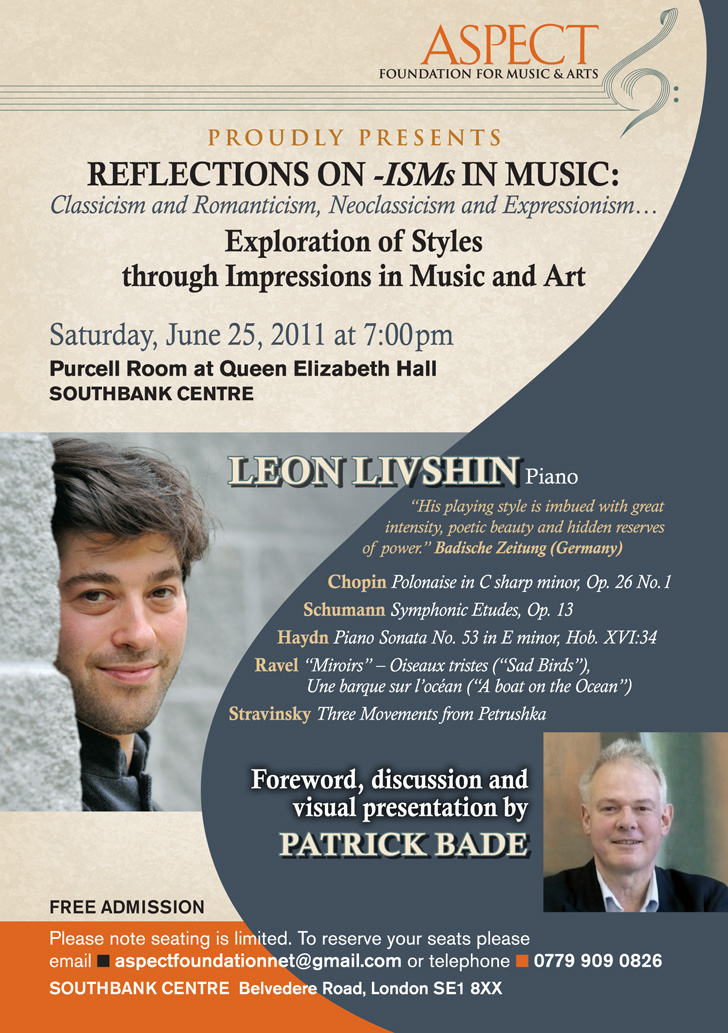
REFLECTIONS ON -ISMS IN MUSIC

Classicism and Romanticism, Neoclassicism and Expressionism…
Exploration of Styles through Impressions in Music and Art.
 
  Videos   Photos                                                    25, 26 June 2011


Home  |  About us  |  Future events  |  Past events  |  Our artists  |  Our supporters  |  Contact us

ASPECT FOUNDATION FOR MUSIC AND ARTS
25 Park Lane, London, W1K 1RA [email protected] TEL: 077 990 908 26
ASPECT Foundation for Music and Arts is a registrered UK charity. number 1141918
Система управления сайтом HostCMS v. 5